
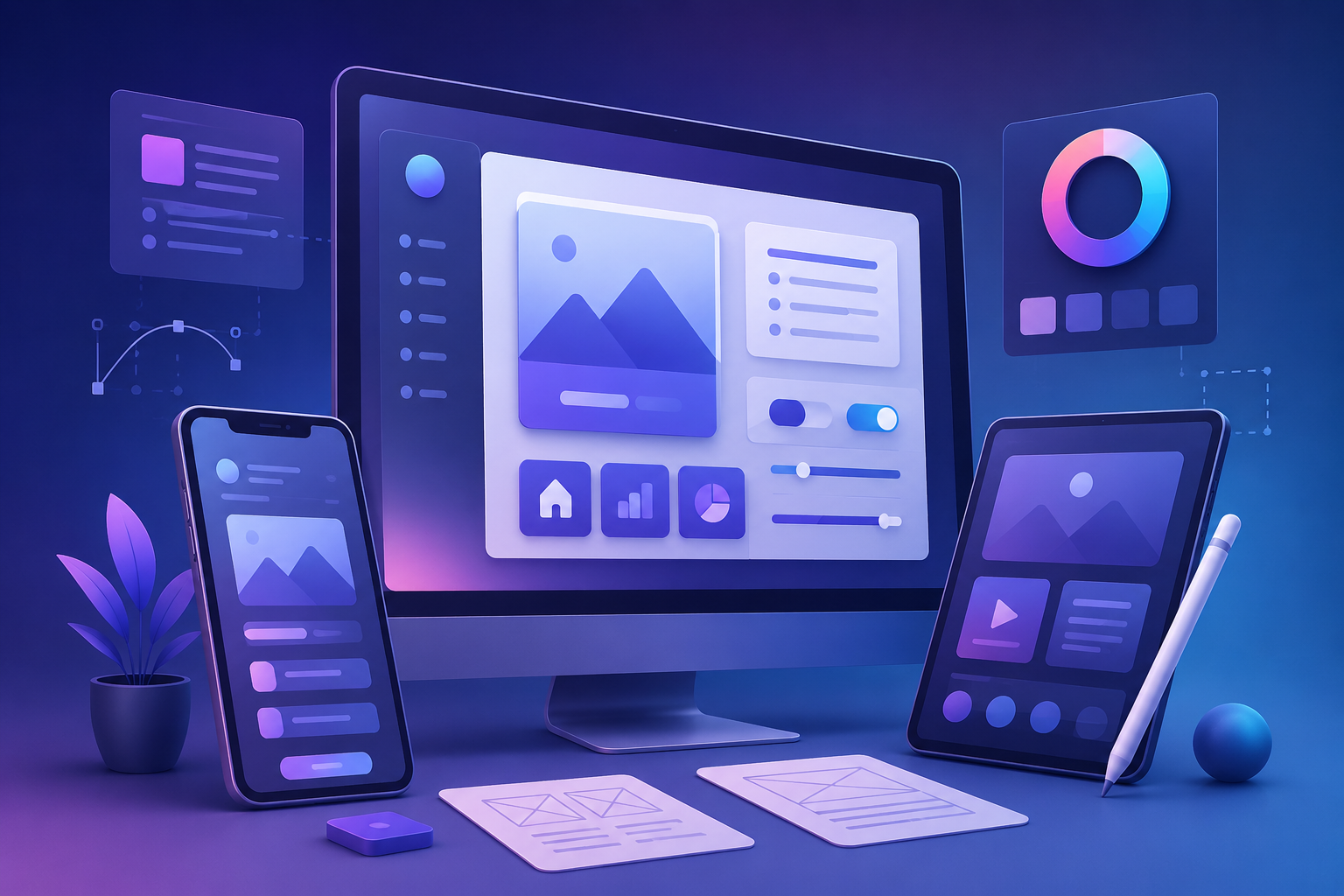

UI/UX design plays a critical role in creating digital experiences that are intuitive, visually engaging, and user-focused. Modern businesses must design digital platforms that not only look appealing but also provide seamless functionality and meaningful interactions across websites, mobile applications, and digital services.
User Interface (UI) design focuses on the visual and interactive elements of digital platforms, while User Experience (UX) design focuses on usability, accessibility, and the overall customer journey. Together, UI and UX design help businesses create digital ecosystems that improve engagement, strengthen customer satisfaction, and support long-term digital growth.
Understanding UI and UX Design
User Interface Design
UI design focuses on the visual presentation and interactive elements of digital platforms. This includes layouts, typography, buttons, navigation menus, color schemes, icons, animations, and overall visual consistency.
Effective UI design ensures that digital interfaces are visually organized, attractive, and easy to interact with. Well-designed interfaces help users navigate platforms more comfortably while improving engagement and usability.
Consistent visual identity and intuitive interaction elements strengthen brand perception and improve the overall quality of digital experiences.
User Experience Design
UX design focuses on how users interact with digital platforms and how those interactions feel throughout the customer journey.
UX strategies prioritize usability, accessibility, simplicity, and customer satisfaction. Businesses analyze user behavior, interaction flows, customer journeys, and usability challenges to create smoother and more efficient experiences.
A strong UX strategy reduces friction, improves navigation, and ensures that users can complete tasks quickly and comfortably across digital environments.
Creating Intuitive Digital Experiences
Simplifying User Interactions
Effective UI/UX design focuses on simplifying digital interactions so that users can navigate platforms naturally and efficiently.
Clear information structures, organized layouts, intuitive workflows, and responsive interfaces help reduce confusion and improve usability across websites and applications.
Simplified interactions create smoother customer journeys while improving overall satisfaction and engagement.
Improving Navigation and Accessibility
Navigation plays a critical role in digital usability because users must be able to access information and complete actions easily.
Accessible navigation systems, readable interfaces, responsive layouts, and user-friendly interaction patterns improve usability for diverse audiences across multiple devices and environments.
Accessibility-focused design helps businesses create more inclusive and customer-centric digital experiences.
Visual Design and Brand Consistency
Creating Visually Engaging Interfaces
Visual design significantly influences how users perceive digital platforms and interact with brands online.
Clean layouts, balanced visual hierarchy, effective typography, engaging imagery, and consistent design systems help create visually appealing interfaces that strengthen customer engagement.
A visually organized interface improves readability, usability, and overall interaction quality.
Maintaining Consistent Brand Identity
Consistency across digital touchpoints strengthens customer trust and brand recognition.
UI/UX design ensures that colors, typography, interaction styles, messaging, and visual elements remain aligned across websites, applications, and digital platforms.
Unified branding creates more connected and professional digital experiences while improving customer confidence and familiarity.
Personalization and User Engagement
Delivering Personalized Experiences
Modern users expect digital experiences tailored to their preferences, behaviors, and interaction patterns.
Businesses can use analytics, customer insights, and intelligent technologies to create personalized content, adaptive interfaces, and customized interaction flows that improve engagement and relevance.
Personalized experiences help customers feel more connected to digital platforms while improving satisfaction and long-term engagement.
Enhancing Emotional Connection
UI/UX design also focuses on creating emotionally engaging interactions that improve customer perception and trust.
Responsive communication, intuitive interaction flows, thoughtful animations, and customer-focused design strategies contribute to more positive emotional experiences.
Emotionally engaging digital experiences strengthen customer loyalty and create more memorable user journeys.
Responsive and Multi-Platform Design
Optimizing Experiences Across Devices
Modern customers interact with digital platforms through a wide range of devices including desktops, laptops, tablets, smartphones, wearable technology, and other connected digital environments. As customer interaction patterns continue to evolve, businesses must ensure that digital experiences remain accessible, intuitive, and consistent across every device and screen size.
Responsive UI/UX design focuses on creating flexible digital interfaces that automatically adapt to varying screen dimensions, interaction methods, and user environments without compromising usability or visual quality.
Customers expect digital platforms to function smoothly regardless of whether they are browsing through a desktop computer, using a mobile application while traveling, or accessing services through tablets and smart devices. Businesses that fail to deliver consistent cross-device experiences risk increasing frustration, reducing engagement, and negatively impacting customer satisfaction.
Responsive design frameworks improve usability by ensuring that layouts, navigation systems, content structures, images, and interactive elements adjust seamlessly across multiple devices and display environments.
Adaptive interface design allows digital platforms to maintain readability, accessibility, and navigation efficiency regardless of screen size or interaction context.
Mobile responsiveness has become especially important because customers increasingly rely on smartphones for browsing, shopping, communication, and digital service interactions. Businesses must optimize interfaces for touch interactions, smaller displays, and mobile navigation behaviors in order to improve customer convenience and engagement.
Responsive experiences also improve accessibility by supporting diverse user environments and interaction needs. Customers should be able to engage comfortably with digital services regardless of the device, location, or technological context they use.
Performance optimization is another critical component of responsive design. Digital platforms must maintain loading speed, interaction responsiveness, and functionality consistency across varying internet speeds, operating systems, and device capabilities.
Fast-loading and optimized digital experiences improve customer satisfaction while reducing abandonment rates and usability frustrations.
Consistent cross-device experiences further strengthen brand perception because customers receive familiar interaction patterns, navigation systems, and communication structures regardless of the platform they use.
Responsive frameworks also support long-term scalability by allowing businesses to adapt more effectively to emerging devices, technologies, and evolving digital interaction trends.
Organizations that prioritize responsive and device-optimized UI/UX strategies are better positioned to improve accessibility, strengthen engagement, and create more reliable and customer-focused digital ecosystems.
By ensuring that digital experiences remain seamless and intuitive across all devices, businesses can create stronger customer relationships while improving overall usability and digital performance.
Creating Seamless Multi-Channel Experiences
Customers engage with businesses through multiple digital touchpoints including websites, mobile applications, customer portals, support systems, social media platforms, and online communication channels. Modern UI/UX design ensures that these interactions remain connected, synchronized, and consistent across every platform and customer touchpoint.
Seamless multi-channel experiences help businesses create cohesive digital ecosystems where customers can move naturally between platforms without disruption or confusion.
Consistency across digital channels is essential because customers expect familiar interactions, unified communication, and stable usability regardless of how or where they engage with a brand.
Unified branding, consistent navigation systems, synchronized content structures, and aligned interaction patterns improve customer confidence and strengthen overall digital experience quality.
Multi-platform consistency also improves convenience by allowing users to continue interactions across devices and channels without needing to relearn workflows or navigation structures.
Connected digital ecosystems enable businesses to create smoother customer journeys by ensuring that information, engagement history, preferences, and interactions remain aligned across platforms.
Seamless experiences reduce customer frustration because users can transition between websites, mobile applications, support channels, and digital services more efficiently.
Businesses that maintain consistent interaction quality across channels improve customer trust and create more reliable digital environments.
Multi-channel UX strategies also improve operational efficiency by integrating customer engagement processes, communication systems, and digital workflows more effectively.
Responsive and connected digital platforms allow organizations to support customer interactions more efficiently while improving engagement continuity across multiple environments.
Accessibility and usability remain important within multi-channel design because customers interact with digital ecosystems in different contexts and environments. Businesses must ensure that every touchpoint remains intuitive, accessible, and customer-focused regardless of platform or interaction method.
Consistent experience quality across digital channels helps strengthen brand recognition, improve customer loyalty, and create more meaningful long-term customer relationships.
Organizations that prioritize seamless multi-platform experiences are better positioned to create adaptive, customer-centric digital ecosystems that support long-term engagement and business growth.
Effective multi-channel experience strategies ultimately help businesses create connected digital journeys that improve usability, strengthen engagement, and deliver more consistent and satisfying customer experiences across every interaction touchpoint.
Responsive and multi-platform UI/UX design helps businesses create seamless, accessible, and connected digital experiences that improve usability, strengthen customer trust, and support consistent engagement across every device and platform.
Continuous Improvement and UX Optimization
Testing and Refining User Experiences
UI/UX design is not a one-time activity but an ongoing process that requires continuous evaluation, testing, refinement, and adaptation. Digital behaviors, customer expectations, technologies, and interaction patterns constantly evolve, making regular optimization essential for maintaining effective and engaging digital experiences.
Businesses must continuously analyze how users interact with websites, applications, customer portals, and digital services in order to identify areas where usability, accessibility, and engagement can be improved.
Usability testing plays a critical role in understanding how users navigate digital platforms and where friction or confusion occurs throughout the customer journey. Businesses can observe how customers complete tasks, interact with interfaces, and respond to workflows in order to identify opportunities for improving navigation structures and interaction efficiency.
User testing also helps organizations uncover hidden usability challenges that may negatively affect customer satisfaction, engagement, or conversion performance. Even small design inefficiencies can impact how users perceive and interact with digital experiences.
Analytics and behavioral data provide valuable insight into customer engagement patterns, navigation behavior, interaction flows, session duration, bounce rates, and conversion pathways. Businesses can use this information to evaluate how effectively digital platforms support customer goals and engagement objectives.
By monitoring real-time performance metrics, organizations can identify where customers disengage, experience delays, abandon processes, or encounter usability barriers within digital environments.
Customer feedback is another essential component of continuous UX optimization. Direct user input provides businesses with a clearer understanding of customer expectations, frustrations, preferences, and satisfaction levels.
Surveys, reviews, customer interviews, support interactions, and feedback forms help organizations gather actionable insights that support ongoing experience improvement and usability refinement.
Interaction monitoring further strengthens optimization strategies by allowing businesses to evaluate how users engage with digital interfaces across multiple platforms and devices. Understanding interaction behaviors helps organizations improve accessibility, streamline navigation pathways, and simplify workflows more effectively.
Continuous refinement enables businesses to create digital experiences that remain intuitive, responsive, and customer-focused despite changing market conditions and evolving customer expectations.
Iterative UX optimization also helps organizations improve accessibility and inclusivity across digital ecosystems. Businesses can continuously enhance interface readability, responsiveness, assistive technology compatibility, and interaction clarity to support a wider range of users and interaction needs.
Regular testing and refinement improve customer satisfaction because users experience smoother interactions, more efficient navigation, and fewer usability challenges throughout their digital journey.
Organizations that prioritize continuous UX improvement are better positioned to maintain strong customer engagement, improve retention, and create more reliable and user-friendly digital ecosystems over time.
Continuous optimization also supports operational efficiency by helping businesses identify technical limitations, performance bottlenecks, and interaction inefficiencies that may impact digital experience quality.
Businesses that consistently evaluate and improve digital experiences can adapt more effectively to changing customer needs while maintaining high levels of usability, accessibility, and customer satisfaction.
Future-Ready UI/UX Strategies
Modern digital experiences must remain adaptable to rapidly changing technologies, customer behaviors, and market expectations. Future-ready UI/UX strategies focus on building scalable, flexible, and innovation-driven digital ecosystems capable of evolving alongside technological advancement and emerging user needs.
Businesses must design digital experiences that can support long-term growth, integrate emerging technologies, and adapt to changing customer interaction models without compromising usability or engagement quality.
Future-ready UX strategies emphasize scalability because digital platforms must be capable of handling increasing customer demand, expanding functionality, and evolving digital ecosystems over time.
Flexible design systems allow organizations to integrate new features, interaction methods, and digital capabilities more efficiently while maintaining consistent user experiences across platforms.
Emerging technologies such as artificial intelligence, machine learning, predictive analytics, voice interfaces, automation, and intelligent personalization are transforming how digital experiences are designed and delivered.
Businesses that adopt innovation-focused UX strategies can create more adaptive, intelligent, and responsive digital environments that align with changing customer expectations.
AI-powered systems can improve personalization by delivering customized recommendations, adaptive interfaces, predictive engagement, and contextual interactions based on customer behavior and preferences.
Automation technologies further enhance digital usability by simplifying repetitive processes, improving responsiveness, and streamlining customer interactions across digital platforms.
Accessibility remains a critical part of future-ready UX design because digital ecosystems must continue supporting diverse audiences and evolving accessibility standards.
Businesses that prioritize inclusive and accessible experience strategies can create digital environments that remain usable and customer-focused for broader user groups across varying devices and interaction contexts.
Future-ready UI/UX frameworks also support continuous innovation by encouraging organizations to regularly experiment with new interaction models, technologies, and design strategies.
Businesses that invest in ongoing UX innovation can remain more competitive while creating differentiated digital experiences that improve engagement and customer perception.
Adaptability is another essential component of long-term UX success because customer expectations and digital trends evolve continuously. Organizations must remain flexible enough to refine and optimize experiences in response to new technologies, changing behaviors, and emerging digital standards.
Future-ready design strategies help businesses create resilient digital ecosystems capable of maintaining performance, usability, and customer satisfaction despite ongoing technological transformation.
Organizations that prioritize customer-focused design, continuous optimization, accessibility, and innovation are better positioned to strengthen digital engagement, improve loyalty, and create sustainable long-term digital value.
Future-focused UX strategies ultimately enable businesses to deliver seamless, adaptive, and intelligent digital experiences that evolve continuously alongside customer expectations and technological advancement.
Continuous UX optimization and future-ready design strategies help businesses create adaptive, accessible, and customer-focused digital experiences that strengthen engagement, improve usability, and support long-term digital growth.
Effective UI/UX design combines usability, accessibility, personalization, and visual consistency to create seamless digital experiences that strengthen customer engagement, satisfaction, and long-term loyalty.