


Artificial Intelligence (AI) is no longer just a buzzword-it’s a strategic advantage for modern businesses. Enterprises across industries are racing to adopt AI-driven solutions for forecasting, personalization, automation, and decision-making. Among the leaders driving this transformation is Abacus AI, a powerful end-to-end AI platform that helps organizations operationalize machine learning and generative AI at scale.
Abacus AI eliminates the complexities of building, deploying, and maintaining AI models. Instead of requiring a large in-house data science team, enterprises can leverage Abacus AI’s automated pipelines, pre-built models, and customizable workflows to accelerate their AI adoption journey.
What is Abacus AI?
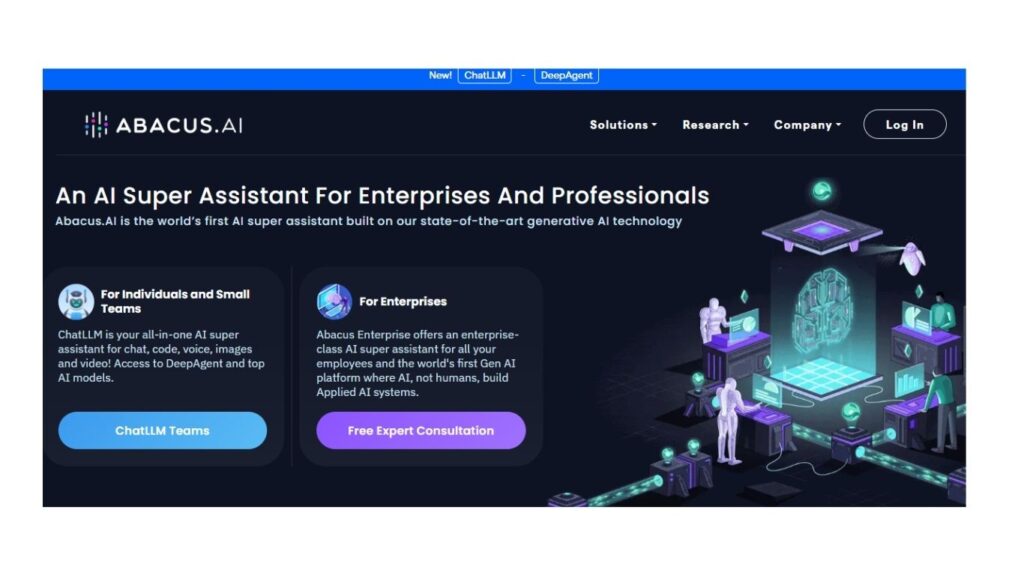
Abacus AI is an enterprise-grade platform designed to simplify the process of creating, deploying, and managing artificial intelligence and machine learning models. Founded by Bindu Reddy in 2019, the company focuses on enabling businesses to integrate AI into their workflows without deep technical expertise.
The platform supports a wide range of AI applications, including:
- Forecasting & Demand Planning
- Personalization & Recommendation Systems
- Anomaly & Fraud Detection
- Natural Language Processing (NLP)
- Generative AI for Text and Images
Unlike traditional AI development, which requires coding, data engineering, and continuous monitoring, Abacus AI automates these processes, allowing businesses to move from idea to deployment in weeks instead of months.
Key Features
1. End-to-End AI Platform
Abacus AI provides a full-stack AI solution, covering everything from data ingestion to real-time predictions. This makes it ideal for enterprises that want a one-stop solution for AI development.
2. Automated Model Training
The platform uses AutoML (Automated Machine Learning) to build, train, and fine-tune models without requiring manual intervention. Businesses can upload their data, and Abacus AI takes care of model selection and optimization.
3. Generative AI Capabilities
Beyond predictive models, Abacus AI offers generative AI features that allow enterprises to create text, images, and personalized content at scale—enhancing customer engagement and creativity.
4. Real-Time Deployment
Abacus AI enables organizations to deploy models directly into production with APIs and integrates seamlessly with existing systems for real-time decision-making.
5. Customizable Pipelines
While automation is its core strength, Abacus AI also allows customization. Data scientists and advanced users can tweak pipelines, integrate third-party tools, and fine-tune models.
6. Continuous Monitoring
AI models can drift over time as business conditions change. Abacus AI includes model monitoring and retraining to ensure accuracy and relevance.
7. Enterprise-Grade Security
With built-in compliance, encryption, and access controls, Abacus AI ensures sensitive enterprise data is always protected.
Use Cases Across Industries
1. Retail & E-commerce
- Personalized product recommendations
- Dynamic pricing and promotions
- Demand forecasting for inventory management
2. Finance & Banking
- Fraud detection in transactions
- Credit risk assessment
- Predictive customer analytics
3. Healthcare
- Patient risk prediction
- Drug discovery using AI models
- Automating medical image analysis
4. Manufacturing
- Predictive maintenance for machinery
- Supply chain optimization
- Quality control using AI vision systems
5. Media & Entertainment
- Content personalization for streaming platforms
- Automated script and content generation with generative AI
- Audience engagement analytics
6. SaaS & Technology
- Customer churn prediction
- Intelligent customer support chatbots
- Optimized onboarding and personalization flows
Benefits
1. Faster AI Adoption
Enterprises can deploy AI in weeks rather than months, accelerating digital transformation.
2. Reduced Costs
By automating model training and deployment, companies save on hiring large data science teams.
3. Scalability
It supports small businesses and global enterprises alike, scaling effortlessly with business growth.
4. Improved Accuracy
AutoML ensures models are optimized, improving prediction accuracy and outcomes.
5. Future-Proof AI
With generative AI integration, businesses can stay ahead of industry trends and continuously innovate.
Read More about Marketing
Abacus AI vs. Traditional AI Development
| Aspect | Traditional AI | Abacus AI |
|---|---|---|
| Development Time | Months to years | Weeks to deploy |
| Technical Expertise Needed | High (data scientists, ML engineers) | Minimal (automation handles complexity) |
| Cost | Expensive (large teams, infrastructure) | Lower (subscription-based, automation-driven) |
| Maintenance | Manual monitoring & retraining | Automated monitoring & retraining |
| Innovation Speed | Slower | Rapid experimentation & deployment |
Pricing & Accessibility
Abacus AI follows a subscription-based model, making it accessible for businesses of all sizes. Plans typically depend on usage, features, and enterprise needs. While small businesses can start with basic features, large enterprises can unlock advanced customization, dedicated support, and full-scale integrations.
The Future
With AI adoption accelerating globally, platforms like Abacus AI are positioned to dominate the enterprise AI landscape. Future enhancements are expected to include:
- Deeper generative AI integrations for enterprise workflows.
- Enhanced explainability features for model transparency.
- Expansion into more industries with specialized pre-built AI models.
By bridging the gap between complex AI development and business usability, Abacus AI is shaping the future of enterprise intelligence.
How Businesses Can Get Started
- Identify AI Opportunities – Start with areas like forecasting, personalization, or anomaly detection.
- Integrate Data Sources – Upload or connect enterprise data to Abacus AI.
- Leverage AutoML – Let the platform train and optimize models automatically.
- Deploy Seamlessly – Integrate models into apps, websites, or backend systems via APIs.
- Monitor & Scale – Continuously track performance and expand use cases over time.
Conclusion
It is more than just another AI tool-it’s a comprehensive platform that enables businesses to adopt AI faster, smarter, and at scale. By combining automation, generative AI, and enterprise-ready features, Abacus AI empowers organizations to unlock new opportunities in forecasting, personalization, anomaly detection, and beyond.
For businesses looking to future-proof their operations and gain a competitive edge, Abacus AI is a transformative partner in the AI journey.