
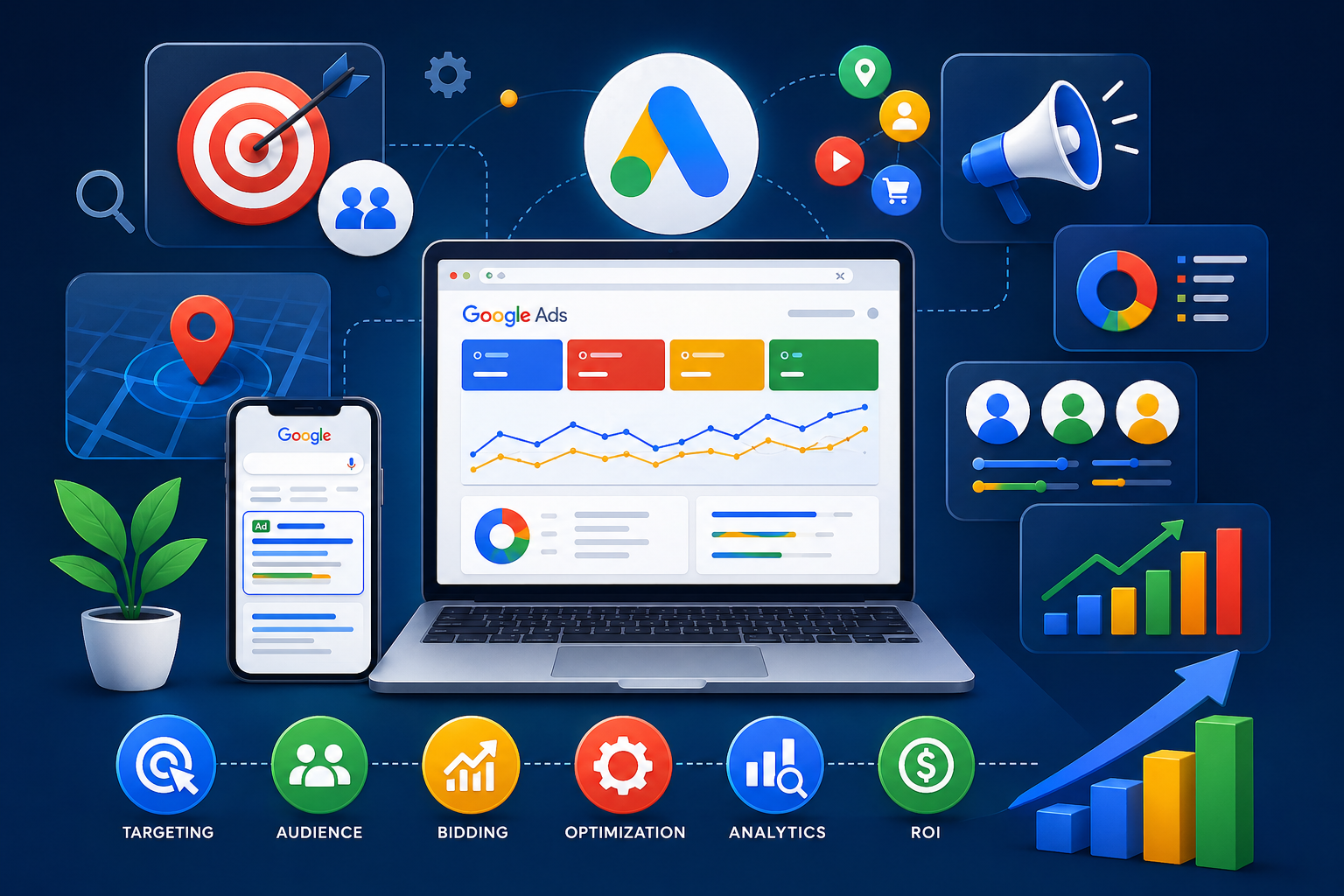

Google Ads marketing solutions play a crucial role in helping businesses achieve targeted visibility, generate high-quality leads, and drive measurable growth. By leveraging data-driven strategies and advanced advertising techniques, these agencies enable brands to reach the right audience at the right time with the right message.
With increasing competition in digital advertising, businesses require expert management of campaigns to maximize return on investment (ROI). A professional Google Ads agency combines strategy, analytics, and continuous optimization to deliver high-performance campaigns.
Strategic Campaign Planning
Strategic campaign planning is the foundation of any successful Google Ads initiative. It involves a structured and data-driven approach to designing campaigns that align with business objectives, target the right audience, and deliver measurable results. A well-planned campaign not only improves performance but also ensures efficient utilization of budget and resources.
Goal-Oriented Campaign Design
Every effective Google Ads campaign begins with clearly defined and measurable objectives. These goals may include generating qualified leads, increasing website traffic, boosting product sales, enhancing brand awareness, or driving app installations.
A strategic approach ensures that each campaign is designed with a specific purpose, rather than adopting a generic model. Agencies work closely with businesses to understand their priorities, target outcomes, and key performance indicators (KPIs). This alignment helps in creating campaigns that are focused, result-driven, and measurable.
Defining clear goals also enables accurate performance tracking. Metrics such as cost per acquisition (CPA), return on ad spend (ROAS), and conversion rates can be monitored effectively, ensuring campaigns remain aligned with business growth strategies.
Audience Targeting Strategy
Audience targeting is a critical component of strategic campaign planning. Google Ads provides advanced targeting capabilities that allow businesses to reach users based on demographics, geographic location, interests, behavior, and search intent.
A well-defined targeting strategy ensures that ads are shown only to the most relevant audience segments, increasing the likelihood of engagement and conversions. Agencies analyze customer personas, buying behavior, and market trends to identify high-value audiences.
Advanced techniques such as remarketing, custom intent audiences, and in-market targeting further refine audience reach. This reduces wasted ad spend and ensures resources are focused on users who are most likely to take action.
Keyword Research and Selection
Keyword research is one of the most crucial aspects of Google Ads campaign planning. It involves identifying the search terms that potential customers use when looking for products or services.
A comprehensive keyword strategy includes high-intent keywords, long-tail keywords, and negative keywords to ensure precise targeting. High-intent keywords capture users ready to convert, while long-tail keywords help target niche audiences with lower competition.
Agencies use advanced tools and performance data to continuously refine keyword lists, ensuring improved efficiency, higher click-through rates (CTR), and better conversion outcomes.
Competitor Analysis
Understanding the competitive landscape is essential for building a strong Google Ads strategy. Competitor analysis involves evaluating advertising strategies, keyword usage, ad creatives, and positioning of competing businesses.
This analysis helps identify gaps and opportunities, enabling agencies to create campaigns that stand out. Businesses can benchmark performance metrics such as cost per click (CPC) and conversion rates to set realistic expectations.
By leveraging competitor insights, campaigns can be optimized for differentiation, ensuring stronger visibility and better engagement in a competitive market.
Budget Planning and Allocation
Effective budget planning is crucial for maximizing campaign performance. It involves strategically distributing the advertising budget across campaigns, ad groups, and keywords to achieve optimal results.
Agencies analyze campaign goals, audience size, keyword competition, and expected outcomes to allocate budgets efficiently. High-performing campaigns are prioritized, while underperforming areas are optimized or adjusted.
Budget management also includes setting limits, monitoring spending patterns, and making real-time adjustments. Advanced bidding strategies and automation tools are used to improve return on ad spend (ROAS) and ensure cost efficiency.
Ad Creation and Optimization
Ad creation and optimization are essential for driving performance in Google Ads campaigns. While targeting ensures ads reach the right audience, it is the quality of the ad and the post-click experience that determines engagement and conversions. A well-crafted ad captures attention, communicates value clearly, and motivates users to take action.
Optimization is an ongoing process that uses performance data to refine messaging, visuals, and user experience. This continuous improvement approach helps maximize return on investment and ensures campaigns remain competitive and effective over time.
High-Impact Ad Copywriting
Effective ad copy is the backbone of successful campaigns. It must instantly capture attention, clearly communicate the value proposition, and encourage users to take action.
Strong ad copy focuses on user intent by addressing their needs and pain points while highlighting benefits over features. Clear and compelling calls-to-action such as “Get Started,” “Buy Now,” or “Learn More” guide users toward the desired outcome.
Incorporating emotional triggers, urgency, and trust signals further enhances engagement. Continuous testing and refinement of headlines and descriptions ensure that the messaging remains relevant, persuasive, and aligned with user expectations.
Creative Visual and Display Ads
Visual elements play a critical role in capturing user attention, especially in display and responsive ads. High-quality graphics, images, and layouts improve engagement and strengthen brand recognition.
Display ads enable businesses to reach audiences across the Google Display Network, increasing visibility beyond search results. Responsive ads automatically adjust their format, size, and appearance to fit different placements, ensuring consistency across devices.
Effective visual design aligns with brand identity and emphasizes clarity, guiding users toward the main message and call-to-action while enhancing overall user experience.
A/B Testing and Experimentation
A/B testing allows businesses to compare multiple ad variations to determine which performs best. Different headlines, visuals, descriptions, and calls-to-action are tested to identify the most effective combinations.
This data-driven approach eliminates guesswork and enables continuous optimization. By analyzing performance metrics, businesses can refine their ads to improve click-through rates and conversions.
Regular experimentation ensures campaigns stay relevant and adapt to changing user behavior, market trends, and competitive dynamics.
Landing Page Optimization
The landing page experience is crucial for converting ad clicks into meaningful actions. A well-optimized landing page ensures that users find relevant information quickly and are guided toward conversion.
Consistency between ad messaging and landing page content builds trust and reduces bounce rates. Key elements include fast loading speed, mobile responsiveness, clear navigation, and strong calls-to-action.
Continuous monitoring of user behavior, such as time on page and conversion rates, helps identify areas for improvement and enhances overall performance.
Ad Extensions Utilization
Ad extensions enhance ads by providing additional information and increasing their visibility in search results. They make ads more informative, interactive, and engaging.
Common extensions include sitelinks, callouts, structured snippets, call buttons, and location extensions. These features allow users to explore more options or take direct actions without additional steps.
Strategic use of ad extensions improves click-through rates, enhances user experience, and contributes to overall campaign success by making ads more relevant and prominent.
Advanced Targeting and Bidding
Advanced targeting and bidding strategies are essential for maximizing the effectiveness of Google Ads campaigns. These techniques ensure that ads are delivered to the most relevant audiences while optimizing costs and improving return on investment. By leveraging automation, segmentation, and data insights, businesses can achieve higher efficiency and better campaign performance.
Smart Bidding Strategies
Smart bidding uses machine learning to automatically optimize bids for conversions and return on investment. It analyzes signals such as user behavior, device, location, and time of day to adjust bids in real time.
This approach eliminates manual guesswork and ensures that budgets are allocated efficiently. Strategies like Target CPA, Target ROAS, and Maximize Conversions help businesses achieve specific campaign goals while improving overall performance.
Geo-Targeting and Local Ads
Geo-targeting enables businesses to focus their campaigns on specific geographic locations. This ensures that ads are shown to users in areas where the business operates or where demand is highest.
Local ads further enhance relevance by targeting nearby users, making them highly effective for location-based businesses. This improves engagement, increases foot traffic, and enhances conversion rates.
Device and Audience Segmentation
Segmenting audiences based on devices and behavior allows for more precise targeting. Users interact differently across mobile, desktop, and tablet devices, and campaigns can be optimized accordingly.
Audience segmentation also considers factors such as interests, demographics, and past interactions, enabling personalized messaging and improved campaign effectiveness.
Remarketing Campaigns
Remarketing allows businesses to reconnect with users who have previously visited their website or interacted with their ads. These users are more likely to convert as they are already familiar with the brand.
By delivering tailored ads based on past behavior, remarketing campaigns improve conversion rates and maximize the value of existing traffic.
Custom Audience Targeting
Custom audiences are created using user data such as interests, search behavior, and previous interactions. This allows businesses to target highly specific segments with personalized messaging.
Custom targeting improves relevance, increases engagement, and ensures that ads are delivered to users who are most likely to convert.
Performance Tracking and Analytics
Performance tracking and analytics provide the foundation for data-driven decision-making in Google Ads campaigns. By measuring key metrics and analyzing performance data, businesses can continuously optimize their strategies and improve results.
Conversion Tracking Setup
Conversion tracking measures key user actions such as purchases, sign-ups, downloads, and inquiries. This helps businesses understand the effectiveness of their campaigns.
Accurate tracking enables better decision-making and ensures that campaigns are aligned with business objectives.
Real-Time Performance Monitoring
Continuous monitoring of campaigns allows businesses to make immediate adjustments based on live data. This ensures that campaigns remain optimized and responsive to changes.
Real-time insights help identify trends, detect issues, and improve performance quickly.
Detailed Reporting and Insights
Comprehensive reports provide detailed insights into campaign performance, including metrics such as impressions, clicks, conversions, and ROI.
These insights help businesses evaluate effectiveness and identify areas for improvement.
Data-Driven Optimization
Analytics enable continuous refinement of campaigns by identifying high-performing keywords, ads, and audience segments.
This ensures that resources are focused on strategies that deliver the best results.
ROI Measurement and Improvement
Measuring return on investment is essential for evaluating campaign success. Agencies focus on maximizing ROI by optimizing targeting, bidding, and ad performance.
Continuous analysis ensures that campaigns remain cost-effective and profitable.
Benefits of Google Ads Marketing Agency
- Increased Visibility – Ads appear prominently on search engines and partner networks, improving brand exposure.
- High-Quality Lead Generation – Targeted campaigns attract users with strong intent, leading to better conversions.
- Precise Audience Targeting – Advanced targeting ensures ads reach the most relevant users.
- Measurable Performance – Detailed analytics provide clear insights into campaign effectiveness.
- Faster Results – Paid campaigns deliver immediate visibility compared to organic strategies.
Challenges in Google Ads Management
High Competition and CPC
In competitive industries, cost per click can be high, requiring careful optimization to maintain profitability.
Complex Campaign Management
Managing multiple campaigns, keywords, and ads requires expertise and continuous monitoring to ensure effectiveness.
Ad Fatigue and Performance Decline
Over time, users may become less responsive to ads, requiring regular updates and creative refreshes.
Conversion Tracking Issues
Incorrect tracking setup can lead to inaccurate data, making it difficult to measure performance and optimize campaigns.
Balancing Budget and Performance
Achieving the right balance between spending and results is essential for maximizing return on investment.
Best Practices for Google Ads Success
- Focus on high-intent keywords to drive better conversions and qualified traffic
- Continuously test and optimize ad creatives to improve engagement and performance
- Use remarketing strategies to re-engage potential customers and increase conversions
- Align ads with optimized landing pages to ensure a seamless user experience
- Leverage analytics and data insights for informed decision-making
- Monitor campaigns regularly and adjust strategies based on performance trends
Successful Google Ads campaigns are built on the perfect balance of data, strategy, and continuous optimization to deliver measurable business growth