
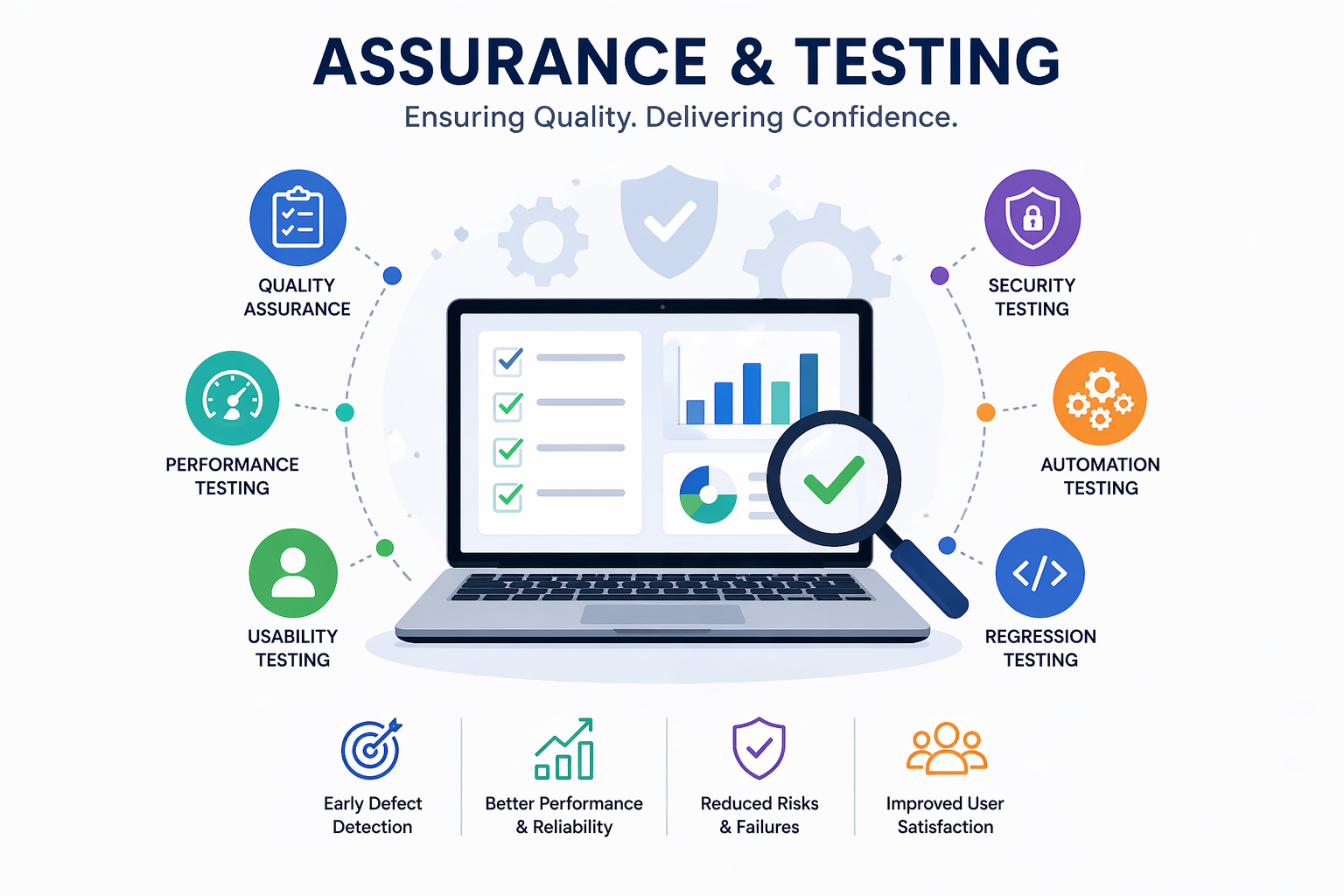

Assurance and testing services play a critical role in ensuring that digital products, applications, and systems function reliably, securely, and efficiently. In today’s technology-driven environment, delivering high-quality user experiences is essential for business success, and testing ensures that systems meet both functional and performance expectations.
These services focus on identifying issues, validating performance, and ensuring that applications meet defined requirements before they are deployed. By integrating assurance and testing into the development lifecycle, businesses can reduce risks, improve quality, and enhance customer satisfaction.
What are Assurance and Testing Services
Assurance and testing services involve evaluating software, applications, and systems to ensure they meet quality standards, performance benchmarks, and user expectations. These services include various testing methodologies, tools, and processes designed to detect defects and improve overall system reliability.
They cover functional validation, performance evaluation, security checks, and usability testing to ensure a seamless and efficient user experience.
Why Assurance and Testing Matter
Assurance and testing are fundamental to delivering reliable, secure, and high-performing digital solutions in today’s competitive and technology-driven environment. As applications become more complex and user expectations continue to rise, ensuring quality is no longer optional—it is a critical business requirement.
Quality assurance and testing help organizations identify issues early, validate functionality, and ensure that systems perform as expected under real-world conditions. By integrating testing throughout the development lifecycle, businesses can reduce risks, optimize performance, and deliver seamless user experiences.
Beyond technical validation, assurance and testing contribute to building trust, protecting brand reputation, and enabling long-term business success.
Ensure Product Quality and Reliability
Testing ensures that applications function correctly, consistently, and reliably across different environments and scenarios. It validates that all features meet defined requirements and perform as expected.
High-quality products reduce the likelihood of failures, enhance stability, and create a positive impression among users.
Reliable systems build confidence and establish credibility in the market.
Identify and Fix Defects Early in the Lifecycle
Detecting issues early in the development process significantly reduces the cost and effort required to fix them. Early testing prevents defects from escalating into larger problems during later stages.
By identifying bugs and inconsistencies early, businesses can improve efficiency and avoid costly rework.
Proactive defect management ensures smoother development and faster delivery.
Improve User Experience and Satisfaction
User experience is a key factor in the success of any digital product. Testing ensures that applications are intuitive, responsive, and easy to use.
Usability testing helps identify areas of friction and improve navigation, design, and interaction.
A seamless user experience leads to higher satisfaction, better engagement, and increased retention.
Enhance System Performance and Scalability
Performance testing ensures that applications can handle varying workloads and maintain optimal performance under stress.
Scalability testing ensures that systems can grow and adapt to increasing user demand without compromising performance.
Optimized performance improves reliability, reduces downtime, and enhances user trust.
Reduce Risks and Operational Failures
Testing helps identify potential risks, vulnerabilities, and failure points before deployment. This reduces the likelihood of system failures, security breaches, and operational disruptions.
By addressing risks proactively, businesses can ensure continuity, protect sensitive data, and maintain compliance with industry standards.
Support Faster and More Confident Releases
With proper assurance processes in place, organizations can release updates and new features with greater confidence. Automated testing and continuous integration enable faster and more reliable deployments.
This helps businesses stay competitive and respond quickly to market demands.
Improve Cost Efficiency and Resource Utilization
Investing in assurance and testing reduces long-term costs by minimizing defects, rework, and downtime.
Efficient testing processes ensure optimal use of resources and improve overall productivity.
Strengthen Brand Reputation and Trust
Delivering high-quality and reliable products enhances brand reputation and builds customer trust.
Consistent performance and positive user experiences create a strong and lasting impression.
Enable Continuous Improvement
Testing provides valuable insights into system performance and user behavior. These insights support continuous improvement and innovation.
Organizations can refine their strategies, enhance features, and adapt to changing user needs.
Key Components of Assurance and Testing
Assurance and testing services are built on a comprehensive set of components that ensure digital systems meet quality, performance, security, and usability standards. These components work together to validate functionality, identify risks, and optimize overall system performance. A well-structured testing approach ensures reliability, reduces defects, and enhances user experience.
Functional Testing
Functional testing ensures that all features and functionalities of an application work as intended. It validates business requirements and confirms that the system behaves correctly under different scenarios.
This includes testing inputs, outputs, workflows, and system interactions to ensure accuracy and reliability.
Functional testing helps identify defects early, ensuring that the application delivers expected results consistently.
Performance Testing
Performance testing evaluates how a system behaves under different workloads and conditions. It ensures that applications remain stable, responsive, and scalable.
This includes load testing, stress testing, endurance testing, and scalability testing.
Performance testing helps identify bottlenecks, optimize resource utilization, and ensure a smooth user experience even under high demand.
Security Testing
Security testing focuses on identifying vulnerabilities and ensuring that systems are protected against potential threats such as data breaches, unauthorized access, and cyberattacks.
It includes vulnerability assessments, penetration testing, and security audits.
By addressing security risks proactively, businesses can protect sensitive data and maintain user trust.
Usability Testing
Usability testing evaluates the user experience of an application, ensuring that it is intuitive, accessible, and easy to navigate.
It focuses on user interactions, design elements, and overall usability.
Improving usability enhances user satisfaction, reduces friction, and increases engagement.
Automation Testing
Automation testing uses scripts and tools to execute test cases efficiently and repeatedly. It improves accuracy, reduces manual effort, and accelerates testing cycles.
Automation is particularly useful for regression testing, performance testing, and repetitive tasks.
It enables faster releases and improves overall testing efficiency.
Regression Testing
Regression testing ensures that new updates, bug fixes, or enhancements do not negatively impact existing functionalities.
It validates system stability after changes and ensures consistency in performance.
Regular regression testing helps maintain product quality over time.
Compatibility Testing
Compatibility testing ensures that applications function correctly across different devices, browsers, operating systems, and environments.
This is critical for delivering a consistent user experience across platforms.
Assurance and Testing Framework
A structured testing framework provides a systematic approach to planning, executing, and optimizing testing activities. It ensures alignment with business objectives and improves efficiency.
Requirement Analysis
This phase involves understanding business and technical requirements to ensure that testing aligns with objectives.
Clear requirements help define scope and ensure that all functionalities are covered.
Test Planning
Test planning involves developing a comprehensive strategy that outlines scope, tools, timelines, resources, and methodologies.
This ensures that testing activities are organized and aligned with project goals.
Test Design
Test design includes creating detailed test cases, scenarios, and scripts to validate different aspects of the system.
Well-designed test cases ensure comprehensive coverage and effective validation.
Test Execution
During execution, test cases are run to identify defects, validate functionality, and evaluate performance.
This phase provides insights into system behavior under real conditions.
Defect Reporting
Defects are documented and tracked systematically. Detailed reporting helps developers understand issues and implement fixes efficiently.
Effective defect management improves collaboration and resolution speed.
Test Closure
Test closure involves evaluating results, ensuring all objectives are met, and documenting outcomes for future reference.
This phase helps identify lessons learned and areas for improvement.
Types of Testing in Assurance Services
Different types of testing are used to validate various aspects of a system, ensuring comprehensive coverage and quality assurance.
Manual Testing
Manual testing involves human testers executing test cases to identify issues and validate functionality.
It is particularly useful for exploratory testing and usability evaluation.
Automated Testing
Automated testing uses tools and scripts to perform repetitive tasks efficiently and improve coverage.
It enhances accuracy and reduces testing time.
Integration Testing
Integration testing ensures that different components or modules of the system work together seamlessly.
It validates data flow and interaction between components.
System Testing
System testing evaluates the complete system to ensure it meets specified requirements.
It validates end-to-end functionality and performance.
User Acceptance Testing (UAT)
UAT ensures that the system meets business requirements and is ready for deployment.
It involves real users validating the system in a practical environment.
Smoke and Sanity Testing
Smoke testing checks basic functionality, while sanity testing ensures that specific changes work correctly.
These tests help quickly identify critical issues.
Tools Used in Assurance and Testing
Modern testing relies on a variety of tools that improve efficiency, accuracy, and coverage.
Test Management Tools
Test management tools help plan, organize, and track testing activities. They provide visibility into progress and performance.
Automation Tools
Automation tools enable the execution of test scripts, reducing manual effort and improving speed.
They support continuous integration and delivery processes.
Performance Testing Tools
These tools simulate real-world conditions to evaluate system performance under different loads.
They help identify bottlenecks and optimize scalability.
Bug Tracking Tools
Bug tracking tools help manage and track defects throughout the testing lifecycle.
They improve collaboration and ensure timely resolution of issues.
Security Testing Tools
Security tools identify vulnerabilities and assess system security.
They help ensure compliance and protect against threats.
Continuous Testing and DevOps Tools
These tools integrate testing into the development pipeline, enabling continuous testing and faster delivery.
They support agile and DevOps practices.
Quote
Effective assurance and testing transform uncertainty into confidence by ensuring that every system performs reliably, securely, and seamlessly
Role of Data in Assurance and Testing
Data plays a crucial role in testing by providing insights into system performance, user behavior, and potential issues. Test data helps simulate real-world scenarios and ensures accurate validation.
Analyzing test results enables continuous improvement and ensures that systems meet quality standards.
Challenges in Assurance and Testing
Assurance and testing are critical for delivering high-quality digital solutions, but they also present a range of challenges that can impact effectiveness, efficiency, and outcomes. As systems become more complex and user expectations continue to evolve, organizations must navigate multiple technical, operational, and strategic hurdles.
Managing Complex Systems
Modern applications are often built using multiple technologies, integrations, and platforms. This complexity makes testing more challenging, as different components must work seamlessly together.
Ensuring end-to-end functionality across interconnected systems requires comprehensive planning, advanced tools, and skilled expertise.
Ensuring Comprehensive Test Coverage
Achieving complete test coverage is difficult due to the wide range of scenarios, devices, environments, and user behaviors that must be considered.
Incomplete coverage can lead to undetected defects, impacting performance and user experience.
Adapting to Evolving Technologies
The rapid pace of technological change introduces new frameworks, platforms, and tools. Testing teams must continuously update their skills and strategies to remain effective.
Emerging technologies such as cloud computing, AI, and microservices architectures add further complexity to testing processes.
Time Constraints and Faster Release Cycles
Agile and DevOps practices demand faster development and deployment cycles. This creates pressure on testing teams to deliver accurate results within limited timeframes.
Balancing speed with quality is a key challenge in modern testing environments.
Resource Limitations
Limited availability of skilled testers, tools, and infrastructure can impact testing efficiency and effectiveness.
Organizations must optimize resources while maintaining high-quality standards.
Integration and Compatibility Issues
Applications often need to integrate with third-party systems, APIs, and platforms. Ensuring compatibility across different environments, devices, and browsers can be complex.
Data Management Challenges
Managing test data, ensuring data privacy, and simulating real-world scenarios require careful planning and execution.
Maintaining Consistency and Quality
Ensuring consistent quality across multiple releases, updates, and environments requires strong processes and continuous monitoring.
Overcoming these challenges requires a structured approach supported by advanced tools, automation, skilled expertise, and continuous improvement strategies.
How ibs fulcro Delivers Assurance and Testing Services
At ibs fulcro, assurance and testing services are delivered through a strategic, integrated, and data-driven approach designed to ensure quality, reliability, and performance across digital solutions.
Strategic Planning and Requirement Alignment
The process begins with a deep understanding of business objectives, technical requirements, and user expectations. This ensures that testing strategies are aligned with overall goals.
Comprehensive Testing Methodologies
A combination of functional, performance, security, and usability testing methodologies is applied to ensure complete validation of systems.
This multi-layered approach ensures that all aspects of the application are tested thoroughly.
Advanced Automation and Tools
Automation is leveraged to improve efficiency, reduce manual effort, and accelerate testing cycles. Advanced tools enable accurate and consistent execution of test cases.
Data-Driven Insights and Optimization
Analytics and data insights are used to identify patterns, measure performance, and refine testing strategies. This ensures continuous improvement and better outcomes.
Agile and DevOps Integration
Testing is integrated into the development lifecycle, enabling continuous testing and faster delivery. This approach supports agility and reduces time-to-market.
Scalable and Flexible Approach
The testing framework is designed to scale with business needs, ensuring adaptability across projects of varying sizes and complexities.
From initial validation to performance optimization, every step is designed to ensure that applications are robust, secure, and ready for real-world deployment.
Best Practices for Assurance and Testing
Implementing best practices ensures that assurance and testing processes are efficient, effective, and aligned with business objectives.
- Define clear testing objectives and scope to ensure alignment with business goals and avoid ambiguity
- Use a combination of manual and automated testing to achieve comprehensive coverage and efficiency
- Ensure end-to-end test coverage across all functionalities, environments, and user scenarios
- Integrate testing into the development lifecycle to enable continuous testing and early defect detection
- Continuously monitor and improve processes through regular analysis and optimization
- Leverage data and analytics to gain insights, improve strategies, and enhance performance
- Adopt a test automation strategy to improve speed, accuracy, and scalability
- Focus on user experience and usability to ensure applications meet user expectations
- Maintain proper documentation and reporting to improve transparency and collaboration
- Encourage collaboration across teams to ensure alignment between development, testing, and business objectives
Quality is not achieved by chance, it is ensured through continuous testing, validation, and improvement