
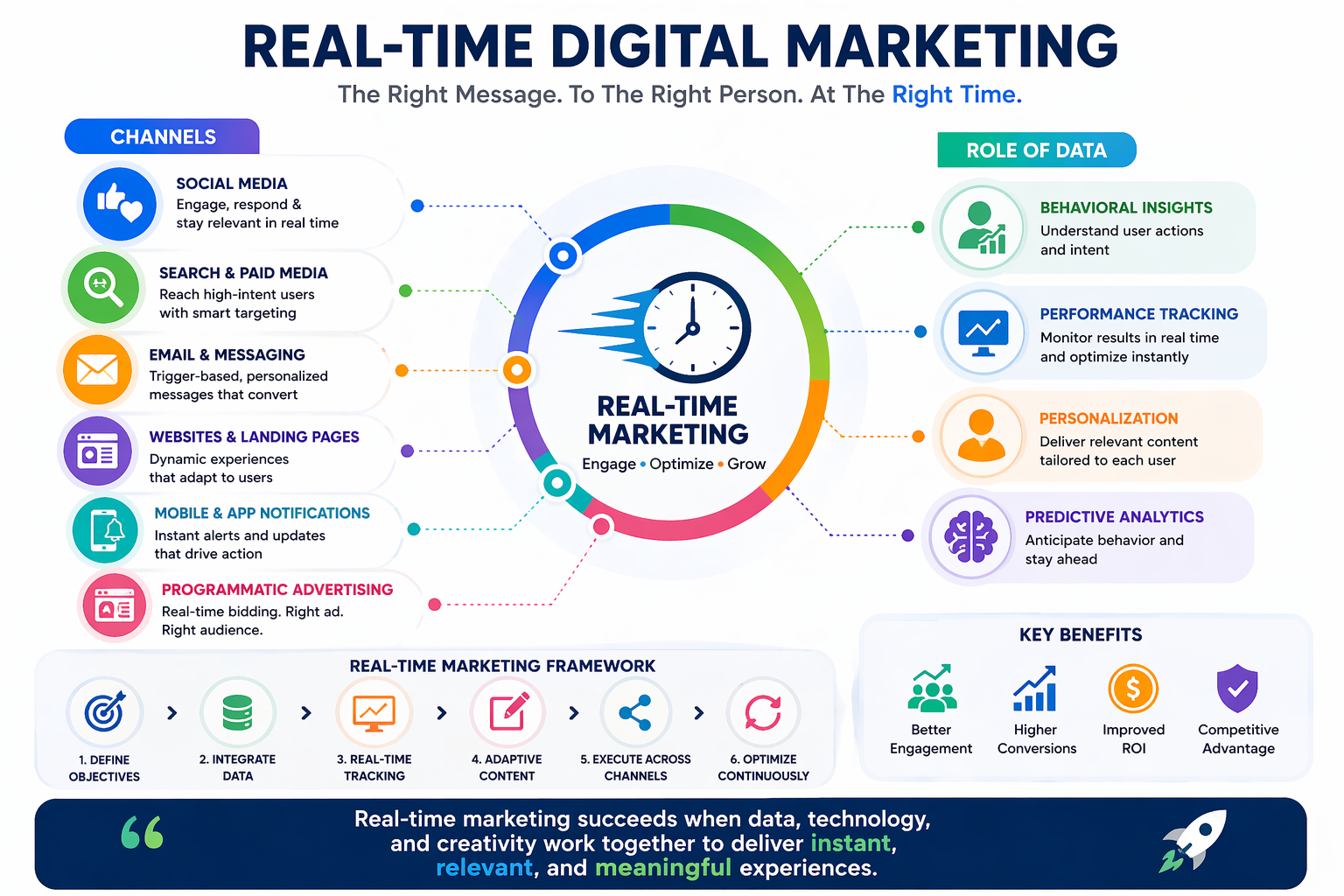

Real-time digital marketing has transformed the way brands connect with their audiences. In an environment where consumer behavior changes rapidly and attention spans are limited, the ability to respond instantly has become a critical competitive advantage.
High-performance campaigns today rely on real-time data, immediate execution, and continuous optimization to deliver impactful results. Real-time marketing enables brands to engage audiences at the right moment, with the right message, across the right channels.
This dynamic approach not only improves engagement but also enhances relevance, efficiency, and overall campaign performance.
What is Real-Time Digital Marketing
Real-time digital marketing refers to the ability to collect, analyze, and act on data instantly to deliver timely and relevant communication. It involves responding to user behavior, market trends, and live events as they happen.
This approach integrates data analytics, automation, and agile execution to create campaigns that are adaptive and responsive.
Why Real-Time Marketing is Critical for High-Performance Campaigns
- Enables instant engagement with users
- Improves relevance and personalization
- Enhances campaign responsiveness
- Maximizes conversion opportunities
- Supports data-driven decision-making
By leveraging real-time insights, businesses can deliver more effective and impactful campaigns.
Key Elements of Real-Time Digital Marketing
Real-time digital marketing is built on a set of core elements that enable brands to respond instantly to user behavior, market trends, and campaign performance. These elements work together to create agile, data-driven campaigns that deliver highly relevant and timely experiences.
Real-Time Data Collection
Real-time data collection involves capturing live data from multiple touchpoints, including website interactions, mobile apps, social media engagement, and campaign performance.
This data includes user clicks, browsing behavior, session activity, and conversion signals, all of which provide immediate insights into user intent.
By collecting and integrating this data continuously, businesses can make informed decisions and respond instantly to changing user behavior.
Advanced tracking systems, cookies, pixels, and APIs play a crucial role in ensuring accurate and real-time data capture.
Instant Analytics and Insights
Analytics tools process large volumes of data in real time, transforming raw information into actionable insights. These insights help marketers understand what is working, what needs improvement, and where opportunities exist.
Real-time dashboards and reporting tools provide visibility into campaign performance, user engagement, and conversion metrics.
This enables quick decision-making, allowing marketers to adjust strategies, budgets, and targeting instantly.
Instant insights also help identify trends, anomalies, and emerging opportunities before competitors.
Dynamic Content Delivery
Dynamic content delivery ensures that users receive personalized and contextually relevant content based on their behavior, preferences, and interactions.
This includes personalized website experiences, adaptive landing pages, and customized ad creatives.
Dynamic content improves engagement by making communication more relevant and meaningful.
It also enhances user experience by delivering the right message at the right time.
Automation and Trigger-Based Actions
Automation is a key driver of real-time marketing, enabling brands to execute campaigns efficiently and at scale. Trigger-based actions are initiated based on specific user behaviors, such as clicks, purchases, or inactivity.
Examples include sending personalized emails, push notifications, or retargeting ads in response to user actions.
Automation ensures consistency, speed, and accuracy while reducing manual effort.
It allows businesses to maintain continuous engagement without delays.
Continuous Optimization
Real-time campaigns are continuously monitored and refined based on performance data. This includes adjusting targeting, messaging, bidding strategies, and content delivery.
Continuous optimization ensures that campaigns remain effective and aligned with objectives throughout their lifecycle.
Testing approaches such as A/B testing and multivariate testing are often used to improve performance.
This iterative process leads to incremental improvements and better outcomes.
Integration of Technology and Platforms
Real-time marketing relies on the seamless integration of various technologies, including analytics platforms, CRM systems, marketing automation tools, and ad platforms.
This integration ensures that data flows smoothly across systems, enabling coordinated and efficient execution.
Real-Time Marketing Framework
A structured framework ensures that real-time marketing strategies are executed effectively and consistently. It provides a roadmap for planning, execution, and optimization.
Define Campaign Objectives
The process begins with setting clear and measurable objectives, such as increasing engagement, driving conversions, or improving brand awareness.
Defined goals provide direction and help evaluate success.
Integrate Data Sources
Combining data from multiple channels creates a unified view of user behavior. This includes data from websites, social media, email campaigns, and paid media.
Integrated data enables better targeting, personalization, and decision-making.
Implement Real-Time Tracking
Real-time tracking systems monitor user interactions and campaign performance continuously. This provides immediate insights into how campaigns are performing.
Tracking tools ensure that data is accurate, timely, and actionable.
Develop Adaptive Content
Content is designed to adapt dynamically based on user behavior and insights. This includes personalized messaging, targeted ads, and customized user experiences.
Adaptive content ensures relevance and improves engagement.
Execute Across Channels
Campaigns are deployed across multiple channels, ensuring that messaging is consistent and aligned. Each channel is optimized based on its unique characteristics and audience behavior.
Cross-channel execution maximizes reach and impact.
Optimize Continuously
Continuous optimization involves analyzing performance data and refining strategies in real time. This includes adjusting targeting, content, and budgets to improve results.
This ongoing process ensures that campaigns remain effective and responsive to change.
Channels in Real-Time Digital Marketing
Real-time digital marketing operates through a dynamic ecosystem of interconnected channels that work together to deliver timely, relevant, and highly personalized communication. Each channel plays a distinct role in capturing attention, driving engagement, and influencing decision-making at different stages of the customer journey.
When these channels are integrated effectively, they create a seamless and responsive marketing environment where every interaction is informed by real-time data and aligned with user intent.
Social Media Platforms
Social media platforms are among the most powerful real-time marketing channels due to their immediacy and interactivity. They enable brands to engage with audiences instantly through posts, stories, live sessions, and direct interactions.
Brands can participate in trending conversations, respond to user queries, and share timely updates, making communication more relevant and engaging.
These platforms support both organic and paid strategies, allowing brands to amplify content, target specific audiences, and optimize campaigns in real time.
Advanced features such as social listening tools and sentiment analysis further enhance real-time engagement by providing insights into audience perception and trends.
Search and Paid Media
Search engines and paid media platforms enable brands to capture high-intent users who are actively searching for solutions. Real-time bidding, dynamic keyword targeting, and audience segmentation allow marketers to adjust campaigns instantly.
Paid media campaigns can be optimized continuously based on performance data, ensuring that budgets are allocated effectively and ads reach the most relevant audience.
Real-time adjustments in bidding strategies, ad creatives, and targeting parameters improve efficiency and maximize return on investment.
Integration with analytics tools ensures that performance insights are immediately reflected in campaign optimization.
Email and Messaging Platforms
Email and messaging channels provide direct and personalized communication, making them highly effective for real-time engagement. Trigger-based campaigns enable brands to send messages based on user actions such as sign-ups, purchases, or inactivity.
Automation tools allow businesses to deliver personalized content at scale while maintaining relevance.
These channels are essential for nurturing relationships, guiding users through the customer journey, and driving conversions.
Advanced segmentation and behavioral targeting further enhance effectiveness by ensuring that each message aligns with user preferences and context.
Websites and Landing Pages
Websites and landing pages act as central hubs for real-time marketing, providing dynamic and interactive user experiences. Content can be adapted instantly based on user behavior, location, device, and preferences.
Personalized landing pages improve engagement and conversion rates by delivering relevant content tailored to individual users.
Real-time data integration enables websites to display targeted offers, recommendations, and messaging.
Optimized user journeys ensure that visitors are guided seamlessly from awareness to conversion.
Mobile and App Notifications
Mobile notifications provide an immediate and direct channel for engaging users. Push notifications, in-app messages, and alerts enable brands to communicate instantly with their audience.
These channels are highly effective for driving immediate actions such as purchases, app engagement, or event participation.
Personalization and timing play a critical role in ensuring that notifications are relevant and non-intrusive.
Real-time triggers ensure that messages are delivered at the most impactful moments.
Programmatic Advertising Platforms
Programmatic advertising uses automation and real-time bidding to deliver ads to targeted audiences with precision and efficiency.
These platforms analyze user data and behavior to determine the best placement, timing, and audience for each ad impression.
Real-time optimization ensures that campaigns are continuously refined for better performance.
This approach enhances scalability and ensures that advertising efforts are both cost-effective and impactful.
Omnichannel Integration
The true power of real-time marketing lies in integrating all channels into a unified ecosystem. Omnichannel strategies ensure that users receive consistent messaging and experiences across platforms.
This integration allows data to flow seamlessly between channels, enabling coordinated and responsive campaigns.
A connected approach enhances user experience and maximizes overall campaign effectiveness.
Role of Data in Real-Time Marketing
Data is the backbone of real-time digital marketing, enabling brands to understand user behavior, measure performance, and make informed decisions instantly. It transforms raw information into actionable insights that drive strategy, personalization, and optimization.
Real-time data allows businesses to respond to user actions as they happen, ensuring that communication remains relevant and impactful.
Behavioral Insights
Behavioral data provides insights into how users interact with campaigns, websites, and platforms. This includes clicks, navigation paths, engagement patterns, and conversion signals.
Understanding behavior helps identify user intent and preferences, enabling more targeted and effective communication.
These insights allow businesses to refine user journeys and improve overall experience.
Performance Tracking
Real-time performance tracking enables marketers to monitor key metrics such as traffic, engagement, conversions, and ROI as campaigns run.
This visibility allows for immediate adjustments to improve effectiveness.
Performance tracking ensures that campaigns remain aligned with objectives and deliver measurable results.
Personalization
Data enables personalized experiences by tailoring content, messaging, and offers based on user behavior, demographics, and preferences.
Personalization improves relevance, engagement, and conversion rates.
By delivering the right message at the right time, brands can create meaningful interactions and build stronger relationships.
Predictive Analytics
Predictive analytics uses historical data and advanced algorithms to forecast future behavior and trends.
This allows businesses to anticipate user needs, optimize campaigns proactively, and stay ahead of competitors.
Predictive insights enhance strategic planning and improve campaign performance.
Real-Time Decision Making
Data empowers marketers to make instant decisions based on current insights. This includes adjusting budgets, targeting, messaging, and campaign strategies in real time.
Quick decision-making improves efficiency and ensures that opportunities are not missed.
Continuous Learning and Optimization
Data creates a continuous feedback loop where insights from performance are used to refine strategies and improve outcomes.
This iterative process ensures that campaigns evolve and adapt to changing conditions.
Continuous optimization leads to sustained growth and improved efficiency.
Data Integration and Unified View
Integrating data from multiple sources provides a unified view of the customer journey. This includes data from websites, social media, email, and paid campaigns.
A unified perspective enables better targeting, personalization, and coordination across channels.
Privacy and Data Governance
With increasing focus on data privacy, ensuring compliance with regulations and maintaining user trust is essential.
Responsible data usage and transparency are critical for sustainable real-time marketing strategies.
Overall, data-driven real-time marketing enables businesses to deliver faster, smarter, and more effective campaigns that adapt to user behavior and market dynamics.
Benefits of Real-Time Digital Marketing
- Improved Engagement through timely and relevant communication
- Higher Conversion Rates by targeting users at the right moment
- Better Customer Experience with personalized interactions
- Increased Efficiency through automation and optimization
- Competitive Advantage by responding faster than competitors
Challenges in Real-Time Marketing
Real-time marketing requires advanced tools, skilled expertise, and efficient processes.
- Managing large volumes of data
- Ensuring data accuracy and integration
- Maintaining consistency across channels
- Balancing speed with quality
- Adapting to rapidly changing trends
Overcoming these challenges requires a structured and data-driven approach.
How ibs fulcro Drives Real-Time High-Performance Campaigns
At ibs fulcro, real-time digital marketing is implemented as an integrated system combining strategy, technology, and analytics.
The approach focuses on capturing real-time insights, delivering dynamic content, and continuously optimizing campaigns to maximize performance.
From data integration and audience targeting to multi-channel execution and optimization, every step is designed to deliver measurable results.
This ensures that campaigns are responsive, efficient, and aligned with business objectives.
Best Practices for Real-Time Digital Marketing
- Leverage real-time data and analytics for informed decision-making
- Use automation and AI tools to improve efficiency
- Focus on personalization and relevance to enhance engagement
- Maintain consistency across channels for a unified experience
- Continuously monitor and optimize campaigns
- Stay agile and adapt quickly to changing trends
Real-time digital marketing is not just about speed, it is about delivering the right message at the right moment to create meaningful and measurable impact